100 Ohm Resistor Color Code — Brown Black Brown Gold
100 ohm resistor color code is Brown-Black-Brown-Gold (10×10). 4/5-band charts, RC timing tables, and wattage on 5–12 V rails.
Decode band colors instantly
Full index: All resistor color code values
100 ohm resistor color code (quick answer)
100 ohm resistor color code = Brown · Black · Brown · Gold → digits 1 · 0, multiplier ×10 → 100 Ω. This page focuses on RC networks and power — not LEDs (see 220 Ω) or pull-ups (10 kΩ).
4-band: Brown · Black · Brown · Gold → 10 × 10 = 100 Ω (±5%) · 5-band (±1%): Brown · Black · Black · Black · Brown → 100 × 1 = 100 Ω (±1%)
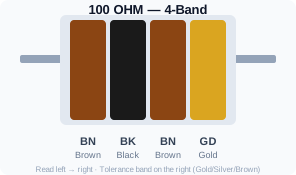
Tolerance window (±5%): 95 Ω – 105 Ω · Calculator
RC time constants with 100 Ω (pick a cap, get a time)
| Capacitor | $\tau = R × C$ | Typical use |
|---|---|---|
| 100 nF | 10 µs | Fast debounce / spike filter |
| 1 µF | 100 µs | Soft-start, short delay |
| 10 µF | 1 ms | Button debounce (with firmware) |
| 100 µF | 10 ms | Power-on reset helper (with MCU) |
Example: 100 Ω + 1 µF → $\tau = 100 Ω × 1 µF = 100 µs$. Five time constants ($5\tau$) ≈ 0.5 ms to reach ~99% of final voltage.
Pair identified 100 Ω parts in networks using the parallel/series calculator.
Power dissipation at common rail voltages
100 Ω is low enough that wattage matters on 12 V+ rails:
| Voltage across 100 Ω | Current | Power $V^2/R$ | Min. rating |
|---|---|---|---|
| 3.3 V | 33 mA | 0.11 W | 1/4 W OK |
| 5 V | 50 mA | 0.25 W | 1/4 W marginal — use 1/2 W |
| 12 V | 120 mA | 1.44 W | Need ≥2 W or different R |
Color code tells you value, not wattage — check body size (1/4 W vs 1/2 W) separately.
100 Ω vs 1 kΩ vs 10 Ω (digit/multiplier traps)
| You want | Bands | Common error |
|---|---|---|
| 100 Ω | Brown · Black · Brown | Confused with 1 kΩ (red multiplier) |
| 10 Ω | Brown · Black · Black | Missing one brown band |
| 1 kΩ | Brown · Black · Red | Red adds a zero |
5-band precision parts
Metal-film 100 Ω ±1%: Brown · Black · Black · Black · Brown → 100 × 1 = 100 Ω (±1%). Range: 99 Ω – 101 Ω. Use these when matching divider legs — see 1 kΩ divider guide.
FAQ
What is the 100 ohm resistor color code?
4-band (±5%): Brown, Black, Brown, Gold. 10 × 10 = 100 Ω (±5%). Actual range: 95 Ω – 105 Ω.
What is the 100 ohm resistor colour code (5-band)?
Brown · Black · Black · Black · Brown → 100 × 1 = 100 Ω (±1%). Range: 99 Ω – 101 Ω.
How do I read a 100 ohm resistor color code?
Read left to right: first bands are digits, then multiplier, then tolerance. For 100 Ω: Brown-Black-Brown = significant digits & multiplier, Gold = tolerance. Use the color code calculator to verify.
Which end do I start reading a 100 Ω resistor from?
Start from the grouped digit bands (left). The tolerance band (Gold) is on the right — gold and silver are almost always tolerance, not multipliers.
What is the difference between 4-band and 5-band for 100 Ω?
4-band (Brown · Black · Brown · Gold) gives 10 × 10 = 100 Ω (±5%) with typical ±5% gold tolerance. 5-band (Brown · Black · Black · Black · Brown) adds a third digit for ±1% precision: 100 × 1 = 100 Ω (±1%) (99 Ω – 101 Ω).
What is the 5-band 100 ohm code?
Brown, Black, Black, Black, Brown for 100 Ω ±1% metal-film.
Related guides (different topics)
- 220 Ω color code — LED brightness vs 330/470 Ω on 5 V
- 1 kΩ color code — divider math & strong pull-ups
- 470 Ω color code — textbook LED history & Y-V family
Topic cluster
More resistor color code guides
Learn the method in our beginner's guide · Decode instantly with the color code calculator