1k Ohm Resistor Color Code — Voltage Divider & Pull-Up Strength
1 kΩ color code (Brown-Black-Red-Gold) with a worked 5 V→2.5 V divider example, pull-up strength vs 10 kΩ, and the 5-band reel-sorting trap.
Decode band colors instantly
Full index: All resistor color code values
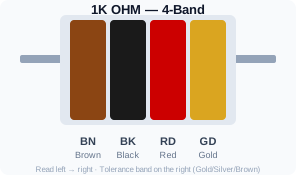
1 kΩ (1000 Ω): Brown · Black · Red · Gold
Digits 1 · 0, multiplier ×100 → 1 kΩ. This guide is about voltage dividers and pull-up strength — not I²C (see 4.7 kΩ I²C guide) or megohm circuits (1 MΩ guide).
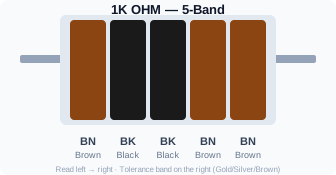
4-band: Brown · Black · Red · Gold → 10 × 100 = 1,000 Ω = 1 kΩ (±5%) · 5-band (±1%): Brown · Black · Black · Brown · Brown → 100 × 10 = 1 kΩ (±1%)
Worked voltage divider (identify two 1 kΩ parts, get 2.5 V from 5 V)
Use two 1 kΩ ±5% resistors in series — equal values → equal split:
| Node | Ideal | With ±5% worst case |
|---|---|---|
| Top to mid | 2.5 V | 2.38 – 2.63 V |
| Mid to GND | 2.5 V | same |
Formula: $V_{out} = V_{in} × R_2 / (R_1 + R_2)$. For equal 1 kΩ: half the supply.
Critical: divider output sags under load. If an ADC input draws current, recalculate with load resistance in parallel — use our voltage divider calculator.
Pull-up strength: why choose 1 kΩ over 10 kΩ?
| Pull-up R | @ 5 V idle current | Rise time (short trace) | Best for |
|---|---|---|---|
| 1 kΩ | 5 mA | Fast | Buttons, fast open-drain, short wires |
| 4.7 kΩ | 1.1 mA | Medium | I²C on short bus |
| 10 kΩ | 0.5 mA | Slower | Default GPIO, low power |
Stronger pull-ups waste power but fight noise — weak pull-ups save battery but need clean PCB layout.
The 5-band 1 kΩ trap (read this before sorting reels)
| Reel label | Bands | Actual value |
|---|---|---|
| 1 kΩ ±1% | Brown · Black · Black · Brown · Brown | 100 × 10 = 1 kΩ |
| 100 Ω ±1% | Brown · Black · Black · Black · Brown | 100 × 1 = 100 Ω |
The fourth band is the multiplier on 5-band parts — not the third. Mixing these reels breaks divider ratios.
FAQ
What is the 1k ohm resistor color code?
4-band (±5%): Brown, Black, Red, Gold. 10 × 100 = 1,000 Ω = 1 kΩ (±5%). Actual range: 950 Ω – 1.05 kΩ.
What is the 1k ohm resistor colour code (5-band)?
Brown · Black · Black · Brown · Brown → 100 × 10 = 1 kΩ (±1%). Range: 990 Ω – 1.01 kΩ.
How do I read a 1k ohm resistor color code?
Read left to right: first bands are digits, then multiplier, then tolerance. For 1 kΩ: Brown-Black-Red = significant digits & multiplier, Gold = tolerance. Use the color code calculator to verify.
Which end do I start reading a 1 kΩ resistor from?
Start from the grouped digit bands (left). The tolerance band (Gold) is on the right — gold and silver are almost always tolerance, not multipliers.
What is the difference between 4-band and 5-band for 1 kΩ?
4-band (Brown · Black · Red · Gold) gives 10 × 100 = 1,000 Ω = 1 kΩ (±5%) with typical ±5% gold tolerance. 5-band (Brown · Black · Black · Brown · Brown) adds a third digit for ±1% precision: 100 × 10 = 1 kΩ (±1%) (990 Ω – 1.01 kΩ).
What is the 1k resistor color code?
Brown-Black-Red-Gold (4-band) or Brown-Black-Black-Brown-Brown (5-band ±1%).
Is 1k the same as 1000 ohms?
Yes — 1 kΩ = 1000 Ω.
Related guides (different topics)
- 10 kΩ color code — button pull-ups & NTC dividers
- 4.7 kΩ color code — I²C rise time & bus capacitance
- 220 Ω color code — LED brightness vs 330/470 Ω on 5 V
Topic cluster
More resistor color code guides
Learn the method in our beginner's guide · Decode instantly with the color code calculator