220 Ohm Resistor Color Code — LED Brightness vs 330 Ω & 470 Ω
220 Ω color code (Red-Red-Brown-Gold) plus the only side-by-side LED brightness table: 220 vs 330 vs 470 Ω on 5 V GPIO, bench math, and 22 Ω confusion trap.
Decode band colors instantly
Full index: All resistor color code values
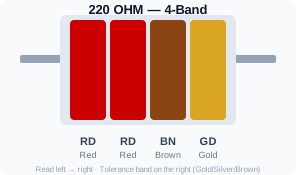
220 ohm resistor color code (quick answer)
220 ohm resistor color code / 220 resistor colour code = Red · Red · Brown · Gold → $22 × 10$ = 220 Ω.
Why 220 Ω shows up in almost every parts kit
Before the color bands: 220 Ω is chosen when you want a visible LED on 5 V without running at the LED's absolute maximum current. The bands Red · Red · Brown · Gold encode $22 × 10$.
4-band: Red · Red · Brown · Gold → 22 × 10 = 220 Ω (±5%) · 5-band (±1%): Red · Red · Black · Black · Brown → 220 × 1 = 220 Ω (±1%)
Full band-reading method: beginner's guide · Reverse lookup: calculator
LED brightness: 220 Ω vs 330 Ω vs 470 Ω (same red LED, same 5 V)
This table is unique to the 220 Ω guide — other value pages cover different topics.
| Series resistor | Approx. current (Vf ≈ 2 V) | Brightness | GPIO stress @ 5 V |
|---|---|---|---|
| 220 Ω | ~13–15 mA | Bright, typical maker default | OK on 3.3 V & 5 V MCUs |
| 330 Ω | ~9 mA | Moderate | Lower power |
| 470 Ω | ~6 mA | Dim but safe | Lowest current of the three |
On 3.3 V with the same LED, 220 Ω drops to ~6 mA — still usable; 330 Ω can look faint. See the 330 Ω guide for the supply-voltage matrix.
Bench calculation (5 V → red LED)
| Step | Value |
|---|---|
| Supply | 5 V |
| LED $V_f$ | ~2.0 V |
| Target $I$ | ~15 mA |
| $R = (5 − 2) / 0.015$ | ≈ 200 Ω → stock 220 Ω |
| Resistor power | $3 V × 15 mA ≈ 45 mW$ (1/4 W fine) |
Use our LED series resistor calculator for other colors — blue/white $V_f$ is higher.
When not to use 220 Ω
- High-speed data lines — series R depends on impedance spec, not LED math.
- Audio/load boxes — power rating may exceed 1/4 W; calculate $I^2 R$.
- Always-on indicators on battery — consider 1 kΩ–10 kΩ to save energy (10 kΩ pull-up guide).
Confusing 220 Ω with 22 Ω (the #1 kit mistake)
| Value | Bands (4-band) | Multiplier band |
|---|---|---|
| 220 Ω | Red · Red · Brown | ×10 |
| 22 Ω | Red · Red · Black | ×1 |
If your multimeter reads ~22 Ω but you expected 220 Ω, the middle band is almost always the multiplier — re-check band order (tolerance on the right).
FAQ
What is the 220 ohm resistor color code?
4-band (±5%): Red, Red, Brown, Gold. 22 × 10 = 220 Ω (±5%). Actual range: 209 Ω – 231 Ω.
What is the 220 ohm resistor colour code (5-band)?
Red · Red · Black · Black · Brown → 220 × 1 = 220 Ω (±1%). Range: 217.8 Ω – 222.2 Ω.
How do I read a 220 ohm resistor color code?
Read left to right: first bands are digits, then multiplier, then tolerance. For 220 Ω: Red-Red-Brown = significant digits & multiplier, Gold = tolerance. Use the color code calculator to verify.
Which end do I start reading a 220 Ω resistor from?
Start from the grouped digit bands (left). The tolerance band (Gold) is on the right — gold and silver are almost always tolerance, not multipliers.
What is the difference between 4-band and 5-band for 220 Ω?
4-band (Red · Red · Brown · Gold) gives 22 × 10 = 220 Ω (±5%) with typical ±5% gold tolerance. 5-band (Red · Red · Black · Black · Brown) adds a third digit for ±1% precision: 220 × 1 = 220 Ω (±1%) (217.8 Ω – 222.2 Ω).
Is 220 ohm the same as Red-Red-Brown?
Yes for standard 4-band ±5% parts: 22 × 10 = 220 Ω.
Can I use 220 ohm for any LED?
Only if the resulting current is within the LED and GPIO rating — calculate (Vsupply − Vf) / R first.
Related guides (different topics)
- 330 Ω color code — 5 V vs 3.3 V supply matrix
- 470 Ω color code — textbook LED history & Y-V family
- 1 kΩ color code — divider math & strong pull-ups
Topic cluster
More resistor color code guides
Learn the method in our beginner's guide · Decode instantly with the color code calculator