4.7k Ohm Resistor Color Code — I²C Bus Rise Time & Pull-Ups
4.7 kΩ color code (Yellow-Violet-Red-Gold) as a dedicated I²C engineering guide: rise time, bus capacitance, 470 Ω swap disaster, pull-up calculator link.
Decode band colors instantly
Full index: All resistor color code values
4.7 kΩ on the I²C bus (not a generic color-code tutorial)
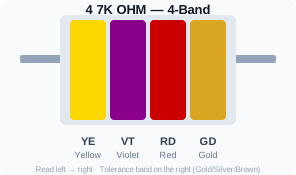
Band colors: Yellow · Violet · Red · Gold → $47 × 100$ = 4.7 kΩ. This entire guide is I²C / SMBus pull-up engineering. For GPIO buttons use 10 kΩ; for LEDs use 220 Ω.
4-band: Yellow · Violet · Red · Gold → 47 × 100 = 4,700 Ω = 4.7 kΩ (±5%) · 5-band (±1%): Yellow · Violet · Black · Brown · Brown → 470 × 10 = 4.7 kΩ (±1%)
Why 4.7 kΩ became the hobby default
I²C lines are open-drain: devices pull SDA/SCL low, pull-ups pull high. $R_{pullup}$ and total bus capacitance $C_b$ set rise time $t_r ≈ 0.847 × R × C$ (simplified).
| Bus | Typical $C_b$ (short PCB) | 4.7 kΩ → $t_r$ (order of) |
|---|---|---|
| 10 cm wires, 2 devices | ~50 pF | ~200 ns — fine @ 100 kHz |
| Breadboard + 20 cm jumpers | 100–400 pF | May fail @ 400 kHz |
When rise time is too slow, scope shows rounded edges and missing ACKs — lower $R$ (2.2 kΩ, 1 kΩ), not higher.
3.3 V vs 5 V modules (same 4.7 kΩ color code)
| Rail | Idle current per line | Notes |
|---|---|---|
| 5 V | ~1.1 mA | Classic UNO + sensor shield |
| 3.3 V | ~0.7 mA | ESP32 / STM32 — same resistor decade, lower power |
Both use Yellow-Violet-Red-Gold for 4.7 kΩ — supply voltage changes power, not the color code.
470 Ω vs 4.7 kΩ (brown vs red — catastrophic swap)
| Value | Multiplier band | 4-band tail |
|---|---|---|
| 470 Ω | Brown ×10 | Y · V · Brown · Gold |
| 4.7 kΩ | Red ×100 | Y · V · Red · Gold |
Plugging a 470 Ω pull-up on I²C by mistake over-consumes current and can prevent proper high level — always verify yellow-violet parts with a meter.
When to use 10 kΩ instead
Long battery life, slow 100 kHz, short traces → 10 kΩ guide. Fast mode, many devices, capacitive bus → try 2.2 kΩ–4.7 kΩ. Use our I²C pull-up calculator for bus-specific values.
FAQ
What is the 4.7k ohm resistor color code?
4-band (±5%): Yellow, Violet, Red, Gold. 47 × 100 = 4,700 Ω = 4.7 kΩ (±5%). Actual range: 4.465 kΩ – 4.935 kΩ.
What is the 4.7k ohm resistor colour code (5-band)?
Yellow · Violet · Black · Brown · Brown → 470 × 10 = 4.7 kΩ (±1%). Range: 4.653 kΩ – 4.747 kΩ.
How do I read a 4.7k ohm resistor color code?
Read left to right: first bands are digits, then multiplier, then tolerance. For 4.7 kΩ: Yellow-Violet-Red = significant digits & multiplier, Gold = tolerance. Use the color code calculator to verify.
Which end do I start reading a 4.7 kΩ resistor from?
Start from the grouped digit bands (left). The tolerance band (Gold) is on the right — gold and silver are almost always tolerance, not multipliers.
What is the difference between 4-band and 5-band for 4.7 kΩ?
4-band (Yellow · Violet · Red · Gold) gives 47 × 100 = 4,700 Ω = 4.7 kΩ (±5%) with typical ±5% gold tolerance. 5-band (Yellow · Violet · Black · Brown · Brown) adds a third digit for ±1% precision: 470 × 10 = 4.7 kΩ (±1%) (4.653 kΩ – 4.747 kΩ).
What is the 4.7k resistor color code?
Yellow-Violet-Red-Gold (4-band ±5%).
Is 4.7k standard for I2C?
It is a common default on short boards; NXP guidelines depend on bus speed and capacitance.
Related guides (different topics)
- 10 kΩ color code — button pull-ups & NTC dividers
- 1 kΩ color code — divider math & strong pull-ups
- 470 Ω color code — textbook LED history & Y-V family
Topic cluster
More resistor color code guides
Learn the method in our beginner's guide · Decode instantly with the color code calculator