330 Ohm Resistor Color Code — Arduino Kit & 3.3 V vs 5 V Matrix
330 Ω color code (Orange-Orange-Brown-Gold): Arduino kit identification, supply-voltage vs LED brightness matrix, breadboard checklist — not a generic band tutorial.
Decode band colors instantly
Full index: All resistor color code values
330 ohm resistor color code (quick answer)
330 ohm resistor color code / 330 resistor colour code = Orange · Orange · Brown · Gold → $33 × 10$ = 330 Ω.
330 Ω & the Arduino starter-kit tradition
Orange · Orange · Brown · Gold → $33 × 10$ = 330 Ω. Both digit bands orange (3) — easy to spot in a mixed pile.
4-band: Orange · Orange · Brown · Gold → 33 × 10 = 330 Ω (±5%) · 5-band (±1%): Orange · Orange · Black · Black · Brown → 330 × 1 = 330 Ω (±1%)
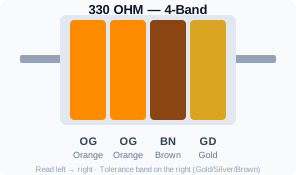
This page is the supply-voltage vs LED brightness reference. Band-reading basics: beginner's guide.
Supply voltage matrix (same 330 Ω, same red LED)
| MCU / rail | $V_f ≈ 2 V$ | Current ≈ $(V−2)/330$ | Visible? |
|---|---|---|---|
| 5 V (UNO) | 2 V | ~9 mA | Yes — kit default |
| 3.3 V (ESP32, Pico 3V3) | 2 V | ~4 mA | Often dim |
| 3.3 V + blue LED ($V_f≈3 V$) | 3 V | ~1 mA | Usually insufficient |
Takeaway: 330 Ω is optimized for 5 V + red/yellow LED. On 3.3 V projects, jump to 220 Ω or calculate with the LED calculator.
Identify 330 Ω in a mixed resistor strip
- Look for two orange bands next to each other (digits side)
- Third band brown (×10), not black (×1 → 33 Ω)
- Fourth gold on the right (±5%)
| If you see | Value |
|---|---|
| Orange · Orange · Brown · Gold | 330 Ω |
| Orange · Orange · Black · Gold | 33 Ω |
| Orange · White · Brown · Gold | 390 Ω |
Breadboard wiring checklist (5 V indicator)
- GPIO → 330 Ω → LED anode (long leg)
- LED cathode → GND
- Confirm polarity — reverse LED won't light regardless of correct color code
- Meter the resistor out-of-circuit if bands are worn
FAQ
What is the 330 ohm resistor color code?
4-band (±5%): Orange, Orange, Brown, Gold. 33 × 10 = 330 Ω (±5%). Actual range: 313.5 Ω – 346.5 Ω.
What is the 330 ohm resistor colour code (5-band)?
Orange · Orange · Black · Black · Brown → 330 × 1 = 330 Ω (±1%). Range: 326.7 Ω – 333.3 Ω.
How do I read a 330 ohm resistor color code?
Read left to right: first bands are digits, then multiplier, then tolerance. For 330 Ω: Orange-Orange-Brown = significant digits & multiplier, Gold = tolerance. Use the color code calculator to verify.
Which end do I start reading a 330 Ω resistor from?
Start from the grouped digit bands (left). The tolerance band (Gold) is on the right — gold and silver are almost always tolerance, not multipliers.
What is the difference between 4-band and 5-band for 330 Ω?
4-band (Orange · Orange · Brown · Gold) gives 33 × 10 = 330 Ω (±5%) with typical ±5% gold tolerance. 5-band (Orange · Orange · Black · Black · Brown) adds a third digit for ±1% precision: 330 × 1 = 330 Ω (±1%) (326.7 Ω – 333.3 Ω).
What is the 330 ohm color code?
Orange, Orange, Brown, Gold (4-band).
330 vs 220 ohm for LEDs?
330 Ω runs lower current (cooler/dimmer); 220 Ω is brighter on the same supply.
Related guides (different topics)
- 220 Ω color code — LED brightness vs 330/470 Ω on 5 V
- 470 Ω color code — textbook LED history & Y-V family
- 1 kΩ color code — divider math & strong pull-ups
Topic cluster
More resistor color code guides
Learn the method in our beginner's guide · Decode instantly with the color code calculator