Resistor Color Code Calculator — Online Decoder
Tap band colors — instant 4, 5 & 6-band decode
Required Parameters
Reverse Lookup
Enter resistance value → get color bands
Waiting for input data...
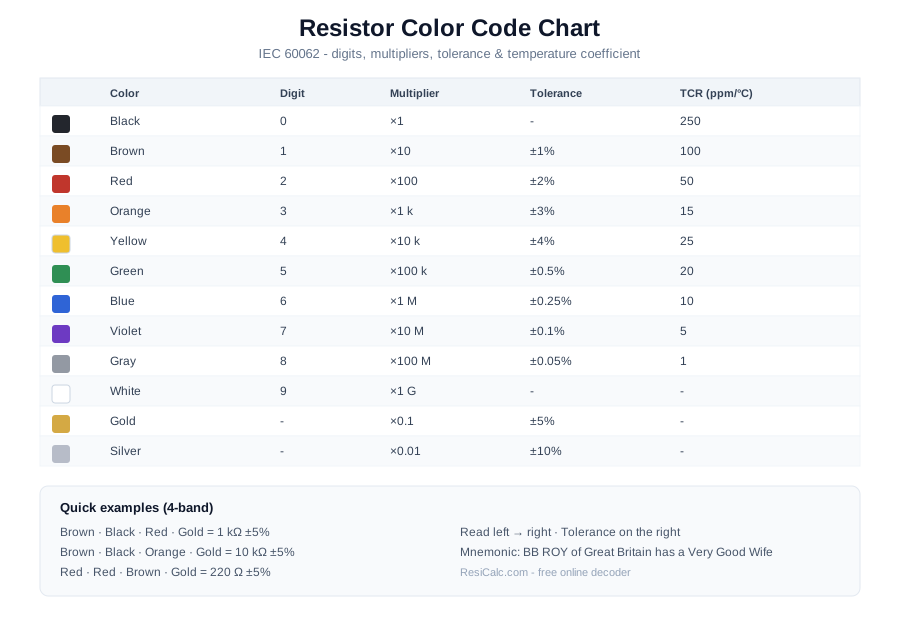
Interactive Resistor Color Code Chart
Tap any color row to inspect digit, multiplier, and tolerance values per IEC 60062. Load a preset example into the decoder above, or print the full chart for bench and classroom use.
Read left → right · Tolerance band (Gold/Silver) on the right
Common examples — load into decoder
Click a color to highlight reference values
| Color | Digit | Multiplier | Tolerance | TCR |
|---|---|---|---|---|
Black | 0 | ×1 | — | 250 ppm/°C |
Brown | 1 | ×10 | ±1% | 100 ppm/°C |
Red | 2 | ×100 | ±2% | 50 ppm/°C |
Orange | 3 | ×1 k | ±3% | 15 ppm/°C |
Yellow | 4 | ×10 k | ±4% | 25 ppm/°C |
Green | 5 | ×100 k | ±0.5% | 20 ppm/°C |
Blue | 6 | ×1 M | ±0.25% | 10 ppm/°C |
Violet | 7 | ×10 M | ±0.1% | 5 ppm/°C |
Gray | 8 | ×100 M | ±0.05% | 1 ppm/°C |
White | 9 | ×1 G | — | — |
Gold | — | ×0.1 | ±5% | — |
Silver | — | ×0.01 | ±10% | — |
Selected color
Brown
Mnemonic: Black · Brown · Red · Orange · Yellow · Green · Blue · Violet · Gray · White— read bands left to right; gold/silver tolerance is almost always on the right.
4 Band Resistor Color Code
A 4 band resistor color code uses two digit bands, one multiplier band, and one tolerance band — the default on carbon-film and most hobby-kit parts (±5% gold or ±10% silver). Select 4 Band above and tap colors, or load an example below.
What each of the 4 bands means
| Band | Role | Example |
|---|---|---|
| Band 1 | 1st significant digit | Brown = 1 |
| Band 2 | 2nd significant digit | Black = 0 |
| Band 3 | Multiplier (power of ten) | Red = ×100 |
| Band 4 | Tolerance | Gold = ±5% |
4-band formula
R = (Band1 × 10 + Band2) × Multiplier ± Tolerance
Common 4-band color codes
4-band mistakes to avoid
- Starting from the gold/silver tolerance band — read from the grouped digit side.
- Counting only three bands and forgetting the multiplier is the third band, not the second digit.
- Assuming a 5-band precision part is 4-band — count bands before decoding.
Need a third significant digit or ±1%? Use 5 Band mode above — 5-band adds Band 3 as a digit and moves multiplier/tolerance one position right. Full 4-band walkthrough with chart
Quick Answer
Read resistor color codes left to right: digits first, then multiplier, then tolerance (gold = ±5%). Example: Brown-Black-Red-Gold = 1 kΩ ±5%. Use reverse lookup to find bands for a target value.
Resistor Color Code Calculator
Use this online resistor color code calculator to decode 4-band, 5-band, and 6-band axial resistors into resistance value, tolerance, and temperature coefficient. Select band colors above — results update instantly.
Below the decoder you'll find an interactive color code chart with live band diagram, common examples (1 kΩ, 10 kΩ, 220 Ω), and a printable chart (Print / Save as PDF or download SVG).
New to color codes? Read our step-by-step Beginner's Color Code Guide for the chart, mnemonic, and reading direction. This page is the interactive decoder tool.
How to Read Resistor Color Codes
Step 1: Identify the Reading Direction
Resistors have colored bands painted on them. You need to determine which end to start reading from:
- Look for a gap — There is usually a larger space before the tolerance band. Start reading from the opposite end.
- The metallic band — Gold and Silver are always tolerance bands, so they should be at the end.
- First band near the edge — The first significant band is typically placed closest to one end of the resistor body.
If you're still unsure, use a multimeter to verify your reading direction. Our Reverse Lookup tool can also help — enter the measured value and compare the color output.
Step 2: Decode Each Band
Each color corresponds to a specific number, multiplier, or tolerance value. The standard mapping (per IEC 60062) is:
| Color | Digit | Multiplier | Tolerance |
|---|---|---|---|
| Black | 0 | ×1 Ω | — |
| Brown | 1 | ×10 Ω | ±1% |
| Red | 2 | ×100 Ω | ±2% |
| Orange | 3 | ×1 kΩ | ±3% |
| Yellow | 4 | ×10 kΩ | ±4% |
| Green | 5 | ×100 kΩ | ±0.5% |
| Blue | 6 | ×1 MΩ | ±0.25% |
| Violet | 7 | ×10 MΩ | ±0.1% |
| Gray | 8 | ×100 MΩ | ±0.05% |
| White | 9 | ×1 GΩ | — |
| Gold | — | ×0.1 Ω | ±5% |
| Silver | — | ×0.01 Ω | ±10% |
4-Band Resistor Color Code
The most common type. The formula is:
Resistance = (10 × Band1 + Band2) × Multiplier ± Tolerance
Example: Brown-Black-Red-Gold
- Brown = 1 (first digit)
- Black = 0 (second digit)
- Red = ×100 (multiplier)
- Gold = ±5% (tolerance)
Result: 10 × 100 = 1,000 Ω = 1 kΩ ±5%
This means the actual resistance is between 950 Ω and 1,050 Ω.
5-Band Resistor Color Code
Used for precision resistors (1% or better). Adds an extra significant digit:
Resistance = (100 × Band1 + 10 × Band2 + Band3) × Multiplier ± Tolerance
Example: Brown-Black-Black-Brown-Brown
- Brown = 1 (first digit)
- Black = 0 (second digit)
- Black = 0 (third digit)
- Brown = ×10 (multiplier)
- Brown = ±1% (tolerance)
Result: 100 × 10 = 1,000 Ω = 1 kΩ ±1%
With 1% tolerance, the actual value is between 990 Ω and 1,010 Ω — ten times more precise than the 4-band equivalent.
6-Band Resistor Color Code
6-band resistors include everything from the 5-band format plus a Temperature Coefficient (TCR) band:
| Color | TCR (ppm/°C) |
|---|---|
| Brown | 100 |
| Red | 50 |
| Orange | 15 |
| Yellow | 25 |
| Blue | 10 |
| Violet | 5 |
The TCR tells you how much resistance changes with temperature:
R(T) = R₀ × [1 + TCR × (T − T₀)]
For example, a 1 kΩ resistor with 50 ppm/°C TCR will change by only 0.05 Ω per degree — critical in precision measurement circuits.
Common Resistor Value Color Codes
What is the 10k resistor color code?
- 4-band: Brown (1) → Black (0) → Orange (×1k) → Gold (±5%)
- 5-band: Brown (1) → Black (0) → Black (0) → Red (×100) → Brown (±1%)
What is the 4.7k resistor color code?
- 4-band: Yellow (4) → Violet (7) → Red (×100) → Gold (±5%)
- 5-band: Yellow (4) → Violet (7) → Black (0) → Brown (×10) → Brown (±1%)
What is the 220 Ohm resistor color code?
- 4-band: Red (2) → Red (2) → Brown (×10) → Gold (±5%)
- 5-band: Red (2) → Red (2) → Black (0) → Black (×1) → Brown (±1%)
What is the 1M Ohm resistor color code?
- 4-band: Brown (1) → Black (0) → Green (×100k) → Gold (±5%)
- 5-band: Brown (1) → Black (0) → Black (0) → Orange (×1k) → Brown (±1%)
Related Tools
- SMD Resistor Code Decoder — Surface-mount numeric & EIA-96 markings
- Series & Parallel Resistor Calculator — Combine decoded values
- Ohm's Law Calculator — Apply resistance in circuit math
- LED Resistor Calculator — Size current-limiting resistors
- Color Code Values Hub — 220 Ω, 1k, 10k & more with SVG diagrams
- Color Code Beginner's Guide — Mnemonic & tolerance primer
- Printable Color Chart — Full reference table
Common Mistakes to Avoid
- Reading from the wrong end — Always start from the grouped bands, not the tolerance band.
- Confusing Gray and Silver — Gray is a digit (8), Silver is a tolerance (±10%) or multiplier (×0.01).
- Ignoring the tolerance band — A "470Ω ±5%" and "470Ω ±1%" resistor look almost identical but have very different applications.
- Using color codes for SMD — Surface-mount resistors use numeric codes (e.g., "103" = 10kΩ), not color bands. Use our SMD Resistor Code Calculator instead.
When to Use a Multimeter Instead
Color codes are great for quick identification, but always verify with a multimeter when:
- The resistor is old or discolored (heat can alter band colors)
- You need precision better than the stated tolerance
- The band count is ambiguous (is it 4-band or 5-band?)
- You're working with safety-critical circuits
Industry Standards
- IEC 60062 — Marking codes for resistors and capacitors
- IEC 60115-1 — Fixed resistors for use in electronic equipment
- MIL-PRF-55342 — Fixed resistors, chip, established reliability
- EIA Publication 330 — The International Electrotechnical Commission standard for color coding
Design Notes
The resistor color code system was developed in the 1920s per IEC 60062 to mark axial-lead resistors too small for printed numbers. Modern practice uses 4-band for 5%/10% resistors (E12/E24 series) and 5-band for 1% precision (E96 series). 6-band adds a temperature coefficient band for high-stability applications. Metal film resistors are typically blue/green body with 5 bands; carbon film are beige/tan with 4 bands.
Common Mistakes
- 1
Reading the bands in the wrong direction — always start from the end with grouped bands. The metallic tolerance band (Gold/Silver) is always last.
- 2
Confusing the multiplier band with a digit band — the multiplier represents powers of 10, not an additional digit.
- 3
Ignoring the tolerance band — a ±20% 1kΩ resistor could actually be anywhere from 800Ω to 1200Ω.
- 4
Using a 4-band decoding method on a 5-band resistor — count bands carefully before decoding.
Engineering Handbox
1. Band 1 (Brown) = 1 2. Band 2 (Black) = 0 3. Significant digits = 10 4. Multiplier (Red) = ×100 5. Resistance = 10 × 100 = 1000Ω 6. Tolerance (Gold) = ±5%
Knowledge Base
What is the 4 band resistor color code?
A 4 band resistor color code uses two digit bands, one multiplier, and one tolerance band (usually gold ±5%). Example: Brown-Black-Red-Gold = 1 kΩ ±5%. Use the 4 Band decoder above or the dedicated section on this page.
How do I read a 4-band resistor color code?
Read from left to right: Band 1 = first digit, Band 2 = second digit, Band 3 = multiplier, Band 4 = tolerance. For example, Brown-Black-Red-Gold = 10 × 100 = 1kΩ ±5%.
What is the 10k resistor color code?
For a 4-band 10kΩ resistor: Brown (1), Black (0), Orange (×1k), Gold (±5%). For 5-band: Brown (1), Black (0), Black (0), Red (×100), Brown (±1%).
What does the 4th band on a resistor mean?
The 4th band indicates tolerance — the accuracy range of the resistance value. Gold = ±5%, Silver = ±10%, Brown = ±1%. No band means ±20%.
How do I know which end to start reading from?
Look for a gap between bands. The larger space is before the tolerance band. The grouped bands (closer together) mark the starting end. Metallic bands (Gold/Silver) are always on the tolerance end.
What is the difference between 4-band and 5-band resistors?
4-band resistors have 2 significant digits (e.g., 47 × multiplier). 5-band resistors have 3 significant digits (e.g., 470 × multiplier), allowing more precise values like 47.5kΩ.
What does the 6th band on a resistor indicate?
The 6th band shows the Temperature Coefficient of Resistance (TCR) in ppm/°C. Brown = 100 ppm/°C, Red = 50 ppm/°C, Blue = 10 ppm/°C. It tells you how much the resistance changes with temperature.
What is the color code for a 220 Ohm resistor?
4-band: Red (2), Red (2), Brown (×10), Gold (±5%). 5-band: Red (2), Red (2), Black (0), Black (×1), Brown (±1%).
What is a good mnemonic for remembering resistor color codes?
A popular mnemonic is 'BB ROY of Great Britain has a Very Good Wife' — Black (0), Brown (1), Red (2), Orange (3), Yellow (4), Green (5), Blue (6), Violet (7), Grey (8), White (9).
Where can I get a printable resistor color code chart?
Use the Print / Save PDF button on this calculator page for a full IEC 60062 chart (digits, multipliers, tolerance, TCR). You can also download the SVG chart or open our dedicated Color Code Chart blog page.
What is tolerance in resistance?
Tolerance is the allowed deviation from the nominal resistance value. Gold = ±5%, Silver = ±10%, Brown = ±1%. A 1 kΩ ±5% resistor may measure anywhere from 950 Ω to 1,050 Ω. For precision dividers and op-amp gain networks, use ±1% metal-film parts.
What does tolerance of resistance mean in practice?
Tolerance defines the min/max range of a resistor. Example: 10 kΩ ±5% → 9.5 kΩ to 10.5 kΩ. In parallel networks, individual tolerance errors partially cancel; in series voltage dividers, mismatched tolerances shift the output ratio.
How to read resistors color code for beginners?
Start from the end opposite the tolerance band (gold/silver). First 2–3 bands are digits, next band is multiplier (zeros), last band is tolerance. Brown-Black-Red-Gold = 10 × 100 = 1 kΩ ±5%. Use our interactive calculator above to verify.
Related Engineering Tools
SMD Resistor Code Calculator
3-digit, 4-digit, and EIA-96 markings
Parallel Resistor Calculator
Equivalent resistance for 2–10 resistors in parallel or series
Ohm's Law Calculator
Solve voltage, current, resistance, or power
LED Series Resistor Calculator
Drop the excess voltage safely